
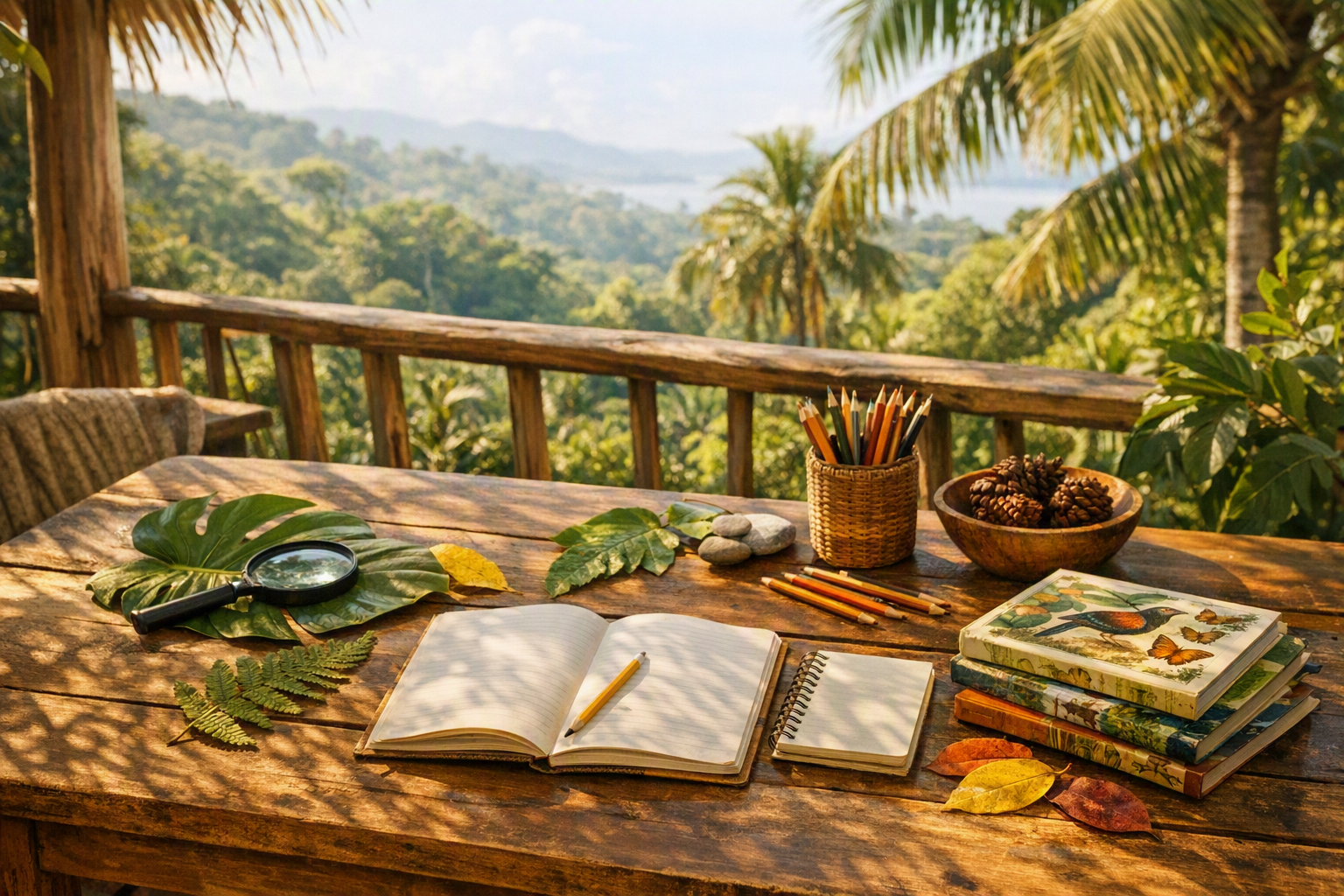
Our individual education story – from the decision and the paperwork to everyday life in the tropics
You might expect that the decision to homeschool our kids came from being unhappy with the school system. That wasn’t the case for us. Our path to homeschooling was completely different from what you might think. Some of my personal views may seem controversial to you. Still, I want to share how we came to individual education, how we arranged it, and what it looks like in practice on the other side of the world.
It Wasn’t Because of the School: Our Experience with Slovak Education
I’m not one of those people who condemn the entire school system. I certainly don’t think I could do a better job of teaching than the teachers at our school back home. To tell the truth, we really loved the school in Čečejovce, Slovakia – both the kids and us parents. The staff are highly qualified and constantly continue their own education. Some might see the fact that it’s a village school as a drawback. The opposite is true. The school keeps up with the times, follows new trends, and its facilities are modern and well maintained. In this respect, I don’t think it lags behind city schools in any way.
I consider its smaller size a big advantage. There’s a kind of family atmosphere there. We never felt that the children were showing off to each other about what they had or who owned more expensive and better things. Admittedly, my kids are still young. However, I hear from parents whose children attend city schools that this is a common reality there, even at such an early age.
In general, I think education in Slovakia is of a fairly high standard. What’s more, it’s free from kindergarten all the way to university. Yes, the curriculum now includes some more liberal topics that personally worry me. However, I don’t think teachers will cover them in great detail. Perhaps I’m influenced by my own experience from primary school. Back then, the required material was simply recited, but teachers didn’t dwell much on things that went against their grain. Parents of older children might see it completely differently. My kids are only in the lower grades of primary school so far, so my experience is limited.
From Bali to Costa Rica: How We Discovered Homeschooling
So, we had no compelling reason to take our kids out of school. We did, however, decide to leave Slovakia. Before we settled on Costa Rica, we considered Bali. I had researched practically everything about the island, including, of course, its schools. I no longer remember exactly how public schools work there. What I do know is that, in the end, I was left with two options.

The first was overpriced international schools taught in English, a language my kids don’t speak yet.The second was individual education at home. That’s when I started looking into the topic more closely. A very helpful resource was the website of the civic association Home Education in Slovakia, where I found all the information I needed. I learned that it’s neither complicated nor impossible. When we started telling the kids that we might move and they would learn at home, they grew more and more excited. My older son, who didn’t enjoy going to school very much, was the happiest of all. When we finally chose Costa Rica, I didn’t even consider any option other than homeschooling.
How to Arrange Individual Education Abroad
Approval from the Home School
The first question was whether our school’s principal would approve homeschooling. It was March and school enrollment was approaching, so it was the ideal time to deal with the matter. If she had refused, we would have chosen the Free Democratic School in Košice (Slovakia), which oversees this form of education in our region. It never came to that. I had always seen the principal as a progressive person, but her reaction was still a huge relief. When we presented our plans, she was genuinely thrilled. She explained that since our permanent address wasn’t changing, the school remained our catchment school. That meant she could approve individual education abroad. She was very helpful in looking up further information for us. In the end, we submitted an application using a form she gave us. Shortly afterward, we received a written decision approving our request.
Textbooks and Required Subjects
Before we left, we received all the textbooks we needed. To be precise, almost all of them, because the curriculum was changing and some of the new textbooks weren’t available yet. We’re required to cover all the core subjects, but not arts, physical education, or electives. I don’t know yet how swapping the textbooks will work at the end of the year. The school is willing to send them by post, but I’m a bit worried whether such a package would even arrive here. That’s something I still need to look into and sort out.
Online Assessment Exams
Assessment exams take place at the parent’s request, either at the end of each school year or at the end of a cycle, which means after three years. The exams would be held online, which is a huge relief, since flights between Costa Rica and Slovakia are really expensive. At the moment, I’m leaning toward yearly exams. If we decided to enroll the kids in a school here, we would have the necessary documents in the form of report cards.
Expectations vs. Reality: Homeschooling in the Tropics
Of course, I imagined the whole thing as incredibly idyllic – beautiful and smooth. I wanted to move at exactly the same pace as the class at our school in Slovakia. Every morning was supposed to start with PE, and music lessons weren’t going to be left out either. Nothing is lost. Still, I think this plan will be more realistic once we have our own comfortable house adapted to our needs.

I didn’t expect the heat to drain so much of my energy. Running around first thing in the morning is out of the question. On some days, the high humidity sends my blood pressure through the floor, and I can barely make myself do anything. Not every day is like that, but those days are part of life in the tropics too.
My plans also failed to account for how different my kids are. Esther would happily copy out her entire handwriting workbook in one go and learn every letter of the alphabet in a single day. Félix, on the other hand, sometimes needs hours of persuading to write even one o – ideally one that doesn’t look like a pear. And then there’s Dávid, who is in a higher grade. He needs me to explain some things in more detail, so teaching him alongside the twins is sometimes impossible.
I already admired the teachers back in kindergarten. After this experience, though, I respect all educators even more. I often struggle to keep three kids in check at once, let alone a whole class of excited children. Even so, we’re making pretty good progress. In some subjects, the kids are ahead of their class; in others, we’re a little behind. But it’s nothing we can’t catch up on. Today, for example, is a nicer day. There was a storm all night, it’s cloudy, and the air feels lighter and cooler. We have to make the most of it.
Education and Homeschooling in Costa Rica
Costa Rica abolished its army after the 1948 civil war and redirected the freed-up funds mainly into education and healthcare. The Constitution even stipulates that public spending on state education must not fall below 6% of GDP per year. You’ll find schools everywhere here, often even near small settlements. Both public and private, often bilingual schools are available, and preschool and primary education are compulsory.
Homeschooling in Costa Rica is neither officially recognized nor regulated by law. According to HSLDA, all minors – both Costa Ricans and foreigners – should attend a school approved by the Ministry of Public Education (MEP). In practice, it’s more of a gray area, which is also addressed in a technical report by Colypro, Costa Rica’s professional association of teachers. In 2025, the Legislative Assembly also reviewed bill No. 24,648, which would regulate homeschooling. The Ministry of Education also offers open education programs (Educación Abierta), but these aren’t homeschooling in the true sense of the word. Our kids remain students of a Slovak school and follow the Slovak curriculum. For now, we live here on tourist visas, and getting permanent residency may take several more years. However, if we decide to enroll the kids in a local school sooner, that’s possible too.
What’s Next? Taking It One Day at a Time
We’ll see how our situation develops here and how the kids get on. A lot will depend on whether they make friends outside the school environment. Perhaps in time we’ll decide it’s better to enroll them somewhere. It will be even more of a question once they reach high school age. But that’s still the distant future. I don’t want to plan too far ahead, so we’re taking it one day at a time. After all, I once thought I would grow old in Seleška. And in the end, we sold everything and started over on a completely different continent.
What about you? Are you considering homeschooling, or do you already have experience with it? Let me know in the comments – I’d love to read your questions and thoughts.
Leave a Reply