
More than two weeks have passed since we arrived in Costa Rica. On the one hand, that is a short time; on the other, I feel as though we have already lived through an entire little chapter here. We are getting used to life on the edge of the jungle, early mornings, heat and humidity, homeschooling, and completely ordinary things like grocery shopping and cooking in someone else’s kitchen. Every day brings something that surprises us, makes us laugh, or forces us to rethink our familiar assumptions. These are our first impressions of our new family rhythm—still unsettled, occasionally chaotic, but all the more honest for it.
When Monkeys Dance on Your Roof
Our rental is essentially one large wooden cabin on the edge of the jungle. Not “close to nature” in the polished, holiday-brochure sense, but genuinely right beside the jungle—with everything that comes with it. Before dawn, we are woken by bats returning from their nightly adventures and sometimes by howler monkeys that have turned our roof into a dance floor. During the first few mornings, every unfamiliar sound made us stop and listen. After all, you never quite know whether to peer excitedly out of the window or stay safely under the sheets. After two weeks, we already treat much of this soundtrack as the local alarm clock.
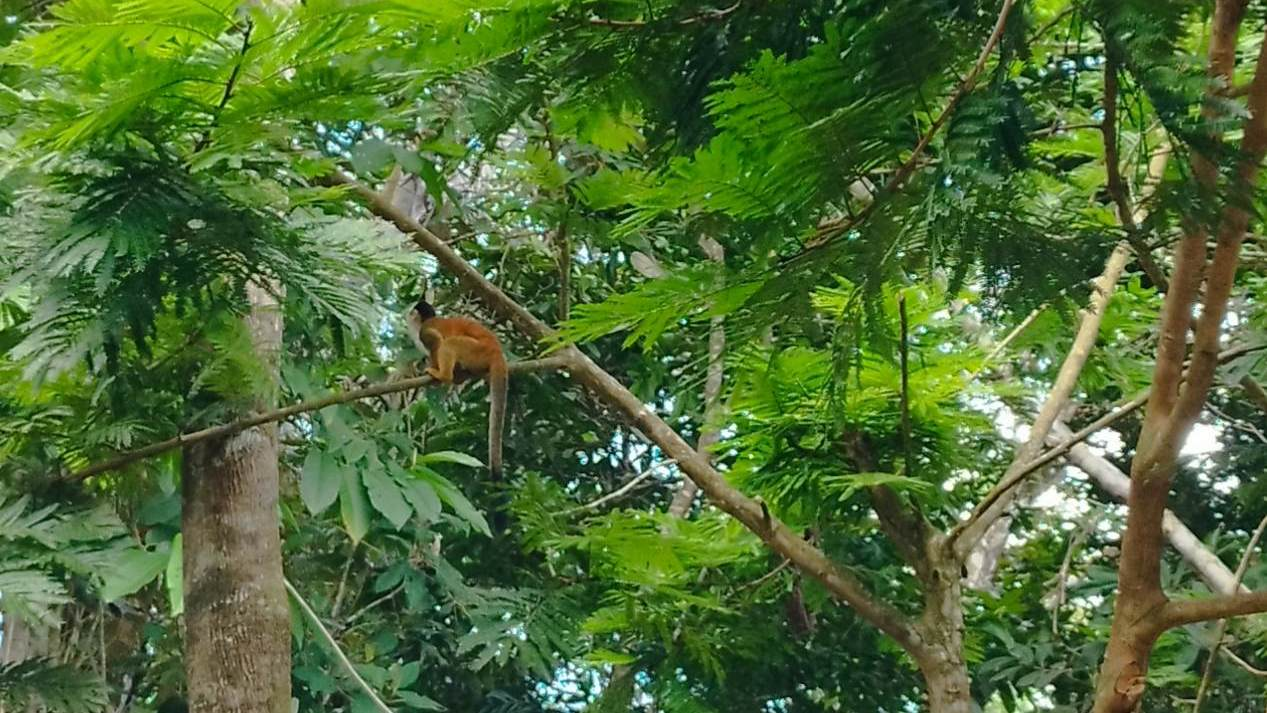
Of course, not every visitor is equally welcome. One day, an enormous spider appeared—at the exact moment when my eternal rescuer in situations like this, Rado, had gone shopping. I stood frozen for half an hour, slipper in hand, watching it so I would not lose track of where it went. When Rado returned, he moved the spider into a pitcher and then onto a banana plant. These days, we barely notice the little lizards clinging to the outside of the windows. We did, however, watch in fascination as one of them caught a moth. During the day, scarlet macaws fly overhead, centipedes hurry beneath our feet, and ants diligently carry away tiny pieces of leaves. Monkey families regularly move through the trees, and when we leave them sliced fruit, they come quite close. For the children, it is science without a textbook; for us adults, it is a daily reminder that we are not the only residents here. In this household, the jungle simply always has an open door.

The Day Starts Earlier Than We Were Used To
We are slowly getting used to the weather too. We usually get up between five and six in the morning, while the temperature is still pleasant. That is when we try to tackle the more physically demanding tasks. Later, we move into the shade under the terrace roof, where a coastal breeze is always blowing. With the fans on as well, it is quite comfortable. Our routine is naturally adapting to the weather: activity in the morning, calmer work during the hottest part of the day, and anything that can be done sitting down.
We are in the middle of the monsoon season, so the air is heavy with humidity. Before we arrived, I imagined it would be worse. The reality is sticky—literally—but not unbearable. I was also delighted by the simple discovery that clothes dry nicely outdoors. We do have a dryer, but I do not like using it unless I have to. Little things like this show me that adapting does not happen through one big decision. It is made up of hundreds of small moments when we realize that something that felt strange or uncomfortable only a few days ago has suddenly become a normal part of life.
Homeschooling with a View of the Greenery
We study with the children in the mornings. By the time we sit down, the school day back home in Slovakia is already over, so I can check EduPage (Slovak school system app where all information about grades, homework, school activities are tracked) to see what they covered that day. We follow along, and for now this system gives us at least a basic sense of security that we will not fall behind. Learning has a different rhythm for each child. Our daughter is enthusiastic and would happily finish the entire workbook at once. The boys need a little persuading, but since they do not have much choice, they eventually complete everything they need to.
Homeschooling in a place like this comes with a special bonus. When we learn about nature, all we have to do is look around. Ants, lizards, butterflies, birds, and monkeys are not pictures on a page; they are part of our day. Of course, that does not mean the children suddenly welcome every assignment with enthusiasm. We are still a normal family, and we still occasionally negotiate over who will sit down “at their desk” and when. But this environment naturally opens up questions and topics we might never have explored at home.


A yellow school bus passes our house every day, taking local children to school. The twins (6) really like seeing the children in their uniforms and are quite open to the idea of enrolling in a local school one day. Our eldest does not want to hear about it yet. I understand him. The twins always have each other, whereas David (8) would find himself alone among unfamiliar children in a completely different environment. For now, however, he has nothing to worry about. Until we have at least temporary residency arranged, we will continue homeschooling—and that process may take another three years. So we are taking it one step at a time. We do not need to have all the answers after two weeks, and I do not want to demand that of ourselves.
From Grocery-Shopping Frustration to Finding Our Own Food Rhythm
As for food and grocery shopping, a little frustration set in after the first week. I expected it, because I had experienced similar beginnings in other countries where I have lived. In an unfamiliar store, you do not know what to reach for, which brands are worth buying, or what to use instead of the things you normally bought at home. It takes time to get to know the local cuisine, stop automatically searching for expensive imported foods, and start cooking with what is available, fresh, and common among local people.
We are gradually putting together a core rotation of meals that we can vary without reinventing the wheel every time we cook. The local diet is based mainly on rice, black beans, eggs, fish, chicken, and fruit. It is not the most varied cuisine in the world, but the individual plates tend to be simple, filling, and made up of foods that provide the body with all the necessary micro- and macronutrients. Personally, I am glad that gluten and cow’s milk are not coming at me from every direction here, which is kinder to my thyroid. The children are gradually finding their reliable favorites too. It does not happen overnight, but we are comparing everything less with what we already know and trying more to work with what is in front of us.
We mostly cook for ourselves, but from time to time we also visit a local soda—a simple restaurant serving home-style food—and order the daily special. For me, it is a pleasant way to get to know local flavors without immediately having to know how to prepare everything myself. And honestly, any day when I do not have to think about cooking gets an automatic little bonus point from me.
The Kitchen, Health, and My Longing for a Cook
While we are on the subject of cooking, the kitchen equipment matters to me too. As you may have read in this article, I successfully recovered from hypothyroidism, and I try to maintain that state partly by choosing carefully the materials that come into contact with our food. The kitchen in our rental is generously equipped, but most of the utensils are plastic or Teflon, and the pots are even made of aluminium. That might not bother someone else at all, but for me it is one of those things I feel better about when I can arrange it my own way.
Last week, my husband went to the capital to look at materials for the construction of our house, so he also bought things we need now and will later take with us to our future home. We replaced the pots and pans with stainless-steel ones, and the cooking utensils and cutting boards with wooden ones. It was a practical purchase, but also a small step toward feeling that we are gradually building something of our own here—even though we are still living in a rental.
We also bought a Ninja air fryer, which I am still getting to know. The fish with green beans turned out fabulously, and a major advantage is that it can prepare four dishes at once. Not that it is an essential part of a healthy kitchen, but the idea of effortless cooking genuinely appeals to me: put everything in, set the time and temperature, and you are done. If I could one day afford any kind of help around the house, it would be a cook. I really do not enjoy cooking. Fortunately, Rado quite likes it and we have similar tastes, so he often helps me with this responsibility. I am very grateful to him for that.
The Biggest Change Is Visible in the Children
And what about the children? It has only been two weeks, but I can already see the positive effect of the change of environment on them, especially on our eldest son. He is only eight, yet at home I sometimes felt as though he was becoming a little teenager too soon. He spent a lot of time watching television and playing computer games—for which, of course, we parents bear the main responsibility—and apart from Lego, he did not have many interests. Here, the child he still is, seems to be waking up again. He observes nature, asks lots of questions, and talks with us. At other times, he plays with water or mud for hours and is much kinder to his siblings. They are a little pack now. They invent their own games, watch what is happening around them, and I love seeing them so carefree again.
I do not want to draw sweeping conclusions after the first two weeks. We are still only at the beginning, and there will certainly be days when we miss something, when the new environment wears us out, or when things do not unfold as we imagined. For now, however, I can see that slowing down, starting our days earlier, spending more time outdoors, and having fewer familiar options give us space to be together more. Not always perfectly, and certainly not without chaos, but more intentionally.
After our first two weeks, we still do not know what life in Costa Rica will bring us. We only know that we are slowly creating a new rhythm here. We are learning to rise with the light, shape our day around the weather, cook with local ingredients, educate our children in our own way, and accept the fact that a lizard or a monkey family may appear outside the window at any moment. Perhaps that is where the biggest change lies: not in having everything figured out already, but in learning to stay curious about what comes next. And so far, I feel that this new chapter is doing our whole family good.
Leave a Reply